About Audubon     Support Audubon
Take Action    Contact Us

CONDORS AND LEAD
IN THE NEWS

San Francisco Chronicle
7-25-07
Get the lead out and save the California condor

California Chronicle
7-23-07
Assemblymember Nava’s Condor Protection Bill Passes Key Senate

Monterey County Herald
7-22-07
Lead bullets in carcass poison released condors

San Francisco Chronicle
7-22-07
Graham Chisholm on getting the lead out of Condors

San Jose Mercury News
7-11-007
Scientists support lead bullet restriction to save Calif condors

Talk of the Bay Public Radio, KUSP
5-
23-07
John Moir and Graham Chisholm on Condors and Lead       Listen: 

Ventura County Star
5-21-07
Shift among Democrats could benefit condors

Pinnacle News 4-6-07
State commission set to vote on lead bullet ban

VC Reporter 4-5-07
Getting the lead out
Because no lead is good lead for California condors

Time Magazine 4-4-07
Taking Aim at Hunters' Ammo


California Condor Information

Condors vs. Lead Bullets

KQED's look at how a new threat-- lead poisoning from old bullets-- is slowing condor recovery

Hi Mountain Condor Lookout

Ventana Wilderness Society

Peregrine Fund

Project Gutpile

US Fish & Wildlife Service California Condor Web Site

Fish & Wildlife Service Condor Web Links

ESRP Natural history profile of the California Condor


Links

AIM “Avian Inventorying and Monitoring”

California Christmas Bird Counts

California’s WatchList Birds

IBAs "Important Bird Areas"


Condors and lead in a 2001 Audubon Magazine article

The California Condor

Bill to Protect Condors from Lead Ammunition
Lands on Governor's Desk

(Sept 5, 2007) Today following a major vote by the California Senate, the legislature has now sent AB 821 by Assemblyman Pedro Nava, legislation banning the use of lead-based ammunition in California condor habitat, to the Governor for signature. The legislation would protect the California condor population from lead poisoning, which is contracted by ingesting bullet fragments left in carcasses and gut piles. The Governor has until October 14th to sign or veto the legislation. Audubon California is calling on Governor Schwarzenegger to sign AB 821.


Banning of Lead Ammunition Would Help
Condor Recovery


Photo by Elena Miras
Natural Light Photography
The endangered California Condor stands to gain from a proposed ban on lead ammunition. The CA Fish & Game Commission has proposed an amendment to hunting regulations to ban lead ammunition in Condor Country, and Assemblyman Pedro Nava has introduced AB 821 as legislation to ban lead ammunition in an effort to aid condor recovery.

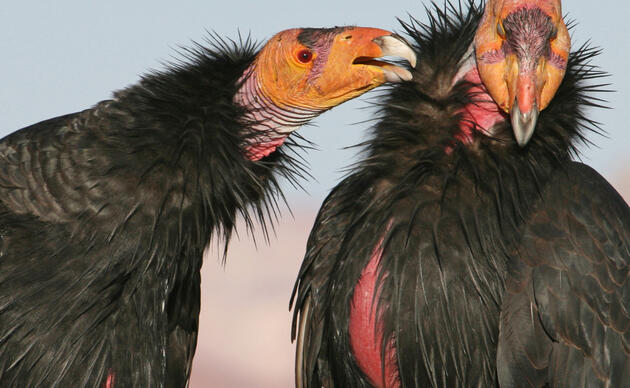
California Condor recovery is a story great successes and remaining challenges. One of the world’s rarest and most imperiled birds, the California Condor was rescued from the brink of extinction by captive breeding and release. Today just 279 condors exist including 70 wild birds in California. Yet despite millions of dollars spent and the Herculean efforts of many people, the condor remains imperiled. A leading threat to condor recovery is lead poisoning from ingestion of ammunition. Since 1992, at least 10 California Condors are known to have died from lead poisoning with more suspected. And since 1997, 30 birds have required expensive medical treatment to remove lead from the blood.


Photo by David Walter
Past attempts to create legislation to ban or limit lead ammunition to aid the recovery of the North America’s largest bird have been unsuccessful. However, the state Fish & Game Commission, who sets the regulations for hunters, has proposed amendments to hunting regulations that would prohibit lead ammunition in current condor country. The Commission will consider this proposal again in Sacramento on August 27th in a special session.

These are critical meetings. A ban on lead ammunition would mean opportunity for self-sustaining populations of California Condors in the wild. For at least seven years, education and incentive programs to promote a voluntary switch to copper ammunition have not reduced lead in condors. Audubon California strongly supports the amendments and applauds the commission’s steps towards reducing lead in the environment.


Audubon California also recommends that the California Fish and Game Commission:ß

  1. create incentives to develop alternatives to lead ammunition and public education programs; and
  2. ask staff to make recommendations for a phased and effective state-wide ban on lead ammunition.

How to Help:

Support AB 821:
Ask the Governor to Sign AB 821
 
Ask Fish and Game Commission to support a ban:
fgc@fgc.ca.gov

Speak at the public meetings:
Anyone can speak to the commission for 2-5 minutes by filling out a green card at the meeting. You can also give the commissioners supporting materials. Please bring 8 copies.
 
27 August 2007, 10:00 am (Special Session)
Sacramento
(location to be announced Aug 17th)

Talking points:

  • Carcasses and gut piles from hunters provide an invaluable food resource to condors throughout their range.
  • Lead ammunition is highly toxic to California Condors and at least 48 other species, including Bald and Golden eagles.
  • Lead fragments are difficult to completely remove from game, posing health risks to hunters and their families eating game. Several studies have found elevated levels of lead in the blood of groups eating game.
  • Lead alternatives, such as copper, have similar performance qualities.

Lead Ammunition alternatives and performance qualities:

For a long list of suppliers see:
Ventana Wildlife Society http://www.ventanaws.org/LeadExposure.htm
Barnes http://www.barnesbullets.com/accuracy_news.php
Project Gutpile http://www.projectgutpile.org/
Arizona Game & Fish http://www.azgfd.gov/w_c/california_condor.shtml

Some scientific references for lead:

Lead levels peak during fall hunting season
http://www.projectgutpile.org/archives/pdf/Fry_2003.pdf
Lead ammunition as principal source in condors
http://pubs.acs.org/cgi-bin/abstract.cgi/esthag/2006/40/i19/abs/es060765s.html
Human lead blood levels in Quebec
http://oem.bmj.com/cgi/content/abstract/60/9/693
Lead sources in human diet in Greenland
http://www.pubmedcentral.nih.gov/articlerender.fcgi?artid=1247612
More human lead blood
http://www.blackwell-synergy.com/links/doi/10.1046/j.1526-0992.1999.09929.x
Lead in game birds
http://www.springerlink.com/content/m43u7531327n0u65/
Fewer fragments in game killed with copper ammunition
http://www.bioone.org/perlserv/?request=get-abstract&doi=10.2193%2F0091-
7648(2006)34%5B167%3ABFIDRI%5D2.0.CO%3B2
49 species affected by lead
http://www.ventanaws.org/pdf/CondorsAndLead/LeadPoisoningStudyFisher_et_al2006.pdf

Links to the Fish and Game Commission:

Meetings http://www.fgc.ca.gov/2007/2007mtgs.html
Amendment language http://www.fgc.ca.gov/2007/proposedregs07.htm#353

Audubon and the California Condor

The magnificent California Condor, among the rarest and most imperiled birds in the world, was famously rescued from the brink of extinction in the late 1900s. Around 200 birds currently survive, roughly half in captivity and half in the wild.

Once found throughout the Southwestern U.S. into Mexico (as well as pockets in New York and Florida), by the early 1900s they were largely confined to the rugged mountains and foothills of Central and Southern California, where they remained until 1987. In that year, the last free-flying wild bird was captured and integrated into an existing captive breeding program. At the time of his capture, this male was one of only 27 living California Condors, whose numbers had dipped to as low as 21 in 1981-82.

From 1987 to 1992, no California Condors flew free in the California skies. In 1992 captive-bred condors were released into the wild at Hopper Mountain National Wildlife Refuge north of Ventura, with additional captive-reared birds added to the flock each year thereafter.

Audubon's relationship with the California Condor has been complex and at times controversial, but has been effective at both the field research level and when focused on pushing for legislation to list the species as Endangered; advocating for land acquisitions around the horseshoe-shaped southern edge of California's Central Valley; and supporting public outreach and education through its magazine and other publications.

The Early Years

Audubon's official involvement with the condor dates back to 1939, when National Audubon Society helped support the doctoral research of Carl Koford, then a student at the University of California, Berkeley. This research was published 1953 as one of three landmark "National Audubon Research Reports" (the other two being Robert Porter Allen’s "Whooping Crane" and James Tanner's monograph of the Ivory-billed Woodpecker), which provided much of the information on the species’ life history.

During the 1930s and 40s, Audubon pressured federal agencies to set aside large parcels of habitat for the condor, even then known to be extremely rare. Two U.S. Forest Service Sanctuaries were established during that time, The Sespe Condor Sanctuary in Ventura County and the Sisquoc Condor Sanctuary in Santa Barbara County (two USFWS refuges for condors have been established subsequently, the Hopper Mountain NWR adjacent to the Sespe Condor Sanctuary, and the Bittercreek NWR in Kern County, near Maricopa).

In 1952, before much was known about captive-rearing of wildlife, the San Diego Zoo was granted permission to establish a captive breeding flock in an attempt to augment the fewer than 100 birds believed left in the wild. These early efforts were a failure, and their permits were revoked after the National Audubon Society (including Carl Koford himself) and other groups protested based on the risk of trying to rescue so rare a bird with so little knowledge of proper captive breeding techniques. Other concerns included the threat of breaking up possible existing pairs and injuring birds during capture and handling.

Seeking to affect the behavior and attitudes of ranchers and rural residents within the range of the condor, Audubon hired "Condor Naturalist" John Borneman in 1964, who served as a sort of Condor Ambassador in the southern California backcountry. John gave talks at Audubon chapters throughout California, and served as an Audubon official on many state and federal agency condor advisory boards. He also lobbied heavily for condor protection and for additional research funds.

Audubon members and chapters continued to push hard for federal action to reverse the condor's decline during the 1960s, and in 1971, the California Condor was included in the first round of animals protected under the U.S. Endangered Species Act. This early victory helped set the stage for Audubon's future work with endangered species elsewhere in the U.S.

The Road to Captivity

In 1979, the "California Condor Recovery Program", which still exists today, was launched by the U.S. Fish and Wildlife Service (USFWS), and in 1980, they and the National Audubon Society jointly founded the "Condor Research Center" in Ventura. This center focused on a number of areas: 1) determining an accurate population estimate; 2) locating and monitoring active nest sites to determine if birds were reproducing; 3) determining feeding areas and sources of food; 4) determining causes of mortality. The program also sought to initiate radio telemetry to accurately monitor condor movements and causes of mortality, and to identify key habitat areas for protection. Finally, it sought to establish a captive breeding program to build the species numbers.

During the early 1980s, captive breeding techniques for rare birds had improved considerably. The San Diego Wild Animal Park was leading the condor breeding program (later expanded to other facilities). The captive breeding program proposed by Audubon, the USFWS, and the San Diego zoo was vociferously opposed by Audubon chapters in California and across the country, particularly by Golden Gate Audubon in the Bay Area. The society and its partners, however, continued to press for captive breeding, setting the stage for even more controversy that would soon transpire.

Condors continued to decline precipitously during the early 1980s. In 1984-85, roughly half (6 out of 15) of the wild population vanished without a trace, dealing a devastating blow to biologists, conservationists and agency personnel alike. From 1981 to 1986, three out of four condors in the wild population were found either dead or dying from lead poisoning. The fourth bird died from ingestion of a cyanide poison found in a coyote-killing device. By 1986, all efforts were focused on removing the last remaining condors from the wild for the captive breeding program.

Opposed to this total elimination of a species from the wild, the National Audubon Society sued the USFWS to prohibit the capture of the last wild birds in 1986, but they were unsuccessful. Audubon hoped that the last wild pair, while being monitored and fed clean (lead-free) food, could serve as a "guide bird" for the proposed release of captive-bred condors. However, when the female of the last pair died from lead poisoning in 1986, it was clear that the only option was to bring the birds in, rather than wait for the last one to die.

Eventually, the last wild condor, AC ("Adult Condor")-9 was captured in 1987. Around the same time and continuing into the 1990s, thousands of acres of land were purchased in the southwestern San Joaquin Valley as future condor habitat, despite the lack of condors in the wild. Of note was the 14,000-acre Bittercreek NWR acquired by USFWS with strong support from Audubon.

Re-building the Population

In 1988, captive condors bred successfully for the first time, and by 1991, an accelerated captive breeding/rearing program had built the population up beyond 50 individuals.

The next year, the first birds were returned to the wild - two captive-born juveniles were released at the Sespe Condor Sanctuary in Ventura County.

The 1990s saw many more birds released, both within California, in Arizona and (in 2003) Baja California. This recent era also brought increased attention to (and frustration with) trying to keep the birds safe from poachers, lead and other threats within their vast foraging range. Individuals found to be habituated to people were quickly brought in for "behavior modification" and most of these would be successfully re-introduced.

Captive breeding programs, located at the Los Angeles Zoo, the San Diego Wild Animal Park, the World Center for Birds of Prey in Idaho (Peregrine Fund) and the Portland Zoo, are now understood to be essential to maintain a large enough pool of release-able birds, with the releases and field monitoring primarily by permitted biologists with the Peregrine Fund in Arizona and by the Ventana Wilderness Society and USFWS Condor Recovery Program in California

In 2001, the first captive-reared birds nested in the wild, in both California and Arizona, though the eggs did not hatch. In 2002 three eggs were laid in California, and though the chicks hatched, all later died of various causes. Still, biologists remain optimistic about the prospect of successfully-breeding wild condors.

A New Era of Condor Conservation

Despite a major expansion in captive breeding and rearing, as well as continuing refinement of release and monitoring techniques and international cooperation (with Mexico), Audubon's involvement with condor conservation actually declined during the late 1980s and 90s, after the last birds were brought in. Some Audubon members who fought passionately for the condors' survival - and for captive breeding - began to direct their support to other conservation groups. Others may have lost interest in its plight, figuring the battle over when the last wild bird was captured in 1987, and viewing the remaining birds to be somehow "artificial". Still others may have assumed that the agencies and zoos had the situation under control, and that it was just a matter of time before condors were fully recovered. Indeed, most of the advocacy on behalf of the condor is done by the various non-Audubon conservation groups and facilities who are directly involved in its preservation.

Interest in condor conservation has remained high at the chapter level. Morro Coast Audubon Society jointly launched (with the USFWS and the U.S. Forest Service) the Hi Mountain Condor Lookout in a renovated fire lookout tower. This site, which acts as a combination staffed visitor's center and research station, opened in 2002 in the hills east of Pismo Beach, between two major release sites at Big Sur and Santa Barbara County. Audubon, assisted by Kern Audubon Society (based in Bakersfield), fought a successful court battle (with Kern County) to halt a proposed "new city" at the northwestern base of the Tehachapi Mountains in the southern San Joaquin Valley. This would not only have affected condors, but many other threatened and endangered species as well. This site, now Wind Wolves Preserve, is being managed and restored by the Wildlands Conservancy.

Audubon magazine recently brought the public's attention to the plight of the condor with a widely-read article in the December 2002 issue. "Project Gutpile", by Jane Braxton Little, described the continuing challenges to condor recovery, including the pervasive effects of lead bullet fragments left behind in deer and other animal carcasses by careless hunters and ranch-hands.

Sadly, soon after the article appeared, one of the last condors born in the wild, AC-8, was shot and killed on Tejon Ranch, which again brought to light the ongoing need for public awareness of condors. With the goal of the Recovery Program to establish three populations of 150 individuals (with 15 breeding pairs each), the environment into which they are released must be made safe.

During the next few years, Audubon will work with experts around California and the U.S. toward a strategy for this new era of condor recovery, where more and more birds are being released widely throughout the Southwest, and their foraging areas increasingly constricted by human settlement and activity. Public education and awareness is needed more than ever before, and Audubon will once again step up to the challenge.

Special thanks to Jesse Grantham formerly with National Audubon Society and now with the US Fish & Wildlife Service in Ventura, California and Dr. Lloyd Kiff of The Peregrine Fund for providing useful comments on this essay.

Home | Staff | Board | FAQ's about Birds | California Birding | California Important Bird Areas
Debs Park Audubon Center | California Centers & Sanctuaries
National Audubon Society | Issues & Action | News | Contact NAS

Audubon California • 765 University Avenue, Suite 200 • Sacramento, CA 95825 • (916) 649-7600 • (916) 649-7667 Fax
Copyright 2002-2006 by Audubon California, Inc. All rights reserved.